hypernova
Publish/subscribe data interchange for control systems — DIP's proven shape (named publications, a registry, subscribe by name) rebuilt on standard OPC UA Pub/Sub (Part 14). The data-interchange fabric of the quasarnova family.
Publications are Part 14 datasets over UDP, readable by any Part 14
implementation — and every supernova
OPC UA server is already a native publisher with a <PubSub> element in its config.
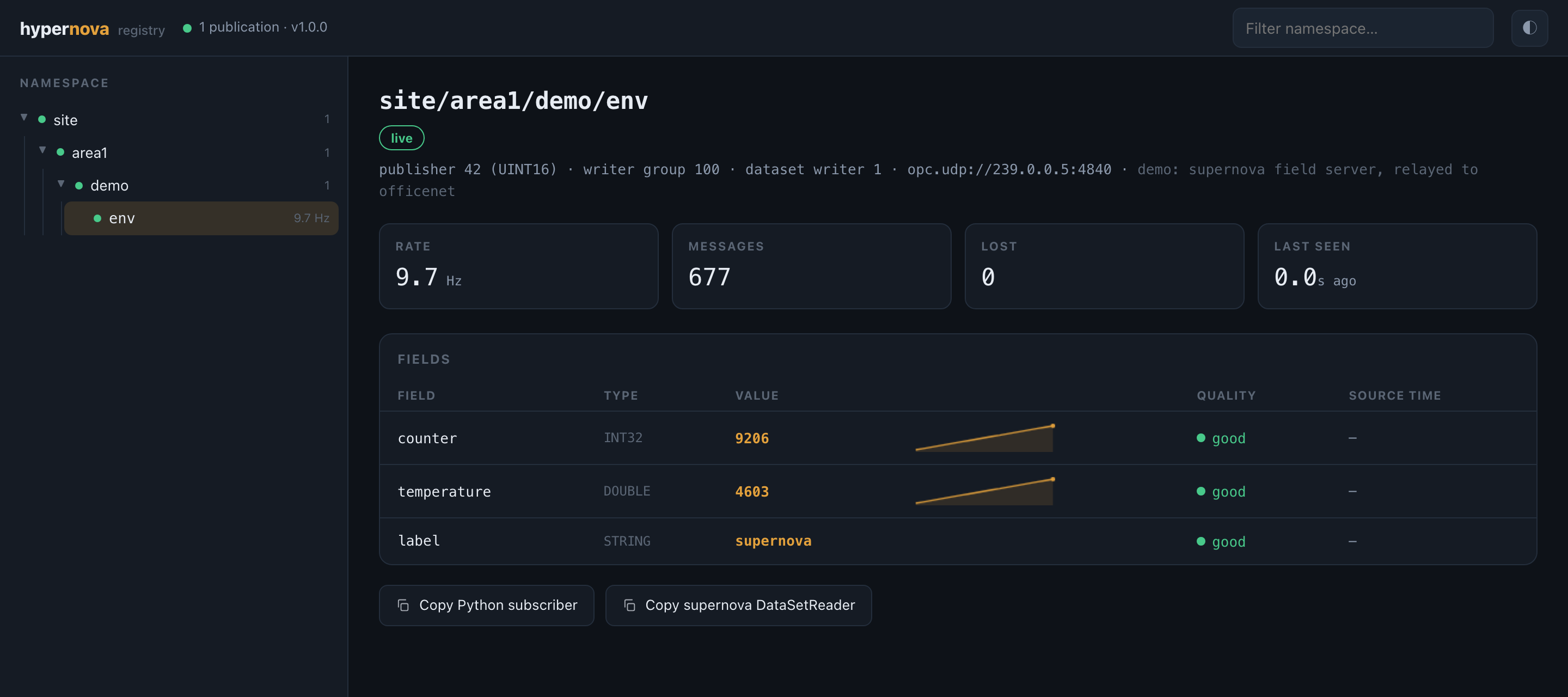
The registry browser: values, quality, rate and per-field sparklines, fed by a real supernova C++ server at ~10 Hz (synthetic demo namespaces).
Install
pip install "hypernova[bridge] @ git+https://github.com/quasarnova-team/hypernova"
# (PyPI's "hypernova" is an unrelated package — install from git)
Five lines, either direction
from hypernova import Subscriber

with Subscriber("site/area1/pump7/env") as sub:
    for update in sub.updates():
        t = update.values["temperature"]
        print(t.value, "good" if t.is_good else hex(t.status))
A dependency-free Java client ships too — clients/java.
Where to next
- Quickstart — the ten-minute tour: registry, publish, subscribe, browse.
- API — Python client, CLI, and the registry's REST surface.
- Security — the signing profile and its honest limits.
- FX connection manager — wiring two OPC UA FX servers together at runtime.
- Deployment — real network boundaries, relays, systemd units.
- On GitHub: Architecture · Vision · DIP parity matrix · Quality record · Changelog
Heritage
hypernova's publish/subscribe shape is inspired by DIP, the Data Interchange Protocol developed at CERN, where it has interconnected control systems for two decades. quasarnova is an independent project and is not affiliated with or endorsed by CERN; hypernova shares no code with DIP — the wire format is standard OPC UA Pub/Sub.